Showing posts with label York Memories. Show all posts

French food in York

Advantages: Great food, good value and good service.

Disadvantages: the space is too small.

We first went to a Café Rouge when we visited York in September 2009. The main reason was we had a GBP10 voucher that could be used in a few restaurants including Café Rouge.

Café Rouge is a renowned French style chain of restaurants that opened its first outlet in 1989. Now it has over 90 across the UK. The one I visited in York is in the heart of the shopping area. It is approximately a 5-10 minute walk from York Minster as well as to Clifford's Tower and York Castle Museum.

The external décor is quite rustic with a red theme. The yellow logo of Café Rouge is on a red sign hanging above the entrance to the restaurant. This appearance makes Café Rouge stand out from other surrounding bars and restaurants. However when I came in I was a little surprised with its size. There were just a few tables, one of which was just inside the entrance. Like other bars you can see a few paintings on the walls. However a large mirror occupied an entire wall that made the space feel bigger.

At Café Rouge you can just have a cup of coffee with a croissant in the morning, or pop in for a spot of lunch or even an evening meal. We were there at about 6pm for dinner. Although there were customers already seated we were served quite fast. The staff were mainly young, friendly and efficient. First they brought the menu for us to choose for our dishes. The menu covers a range of French food to suit most tastes. Likewise their wines are predominately French too. The first two pages of the menu display daily specials, which were almost half the price of a la carte items. However you can’t use vouchers for these daily specials. We sampled the Entrecote rouge, a steak with French fries (£15.95). This was the most expensive main course on their menu. The steak was tender and tasty and the sauce that was provided complemented the meat. However the fries were a little disappointing. I am used to British chips. To me the French fries are too thin and too oily. We also tried an offer of two courses (£9.95). After two months I forget what we had, but I remember it was delicious. Our dinner cost £35 inclusive of beers and a tip. Considering what we had and the quality of the food I would say the price was pretty reasonable. I have not been to France so I can’t say it was genuine French food although I prefer to believe it was.

Next day we had a dinner in a local pub that cost us almost £50 yet the food and the service were a lot poorer than that we were given in Café Rouge. On this basis I would recommend Café Rouge for a chance to taste French food. I felt there was one small disappointment and that was the limited space of the restaurant. It was too crowded due to popularity and I felt like I was sitting in the lap of the next customer. You couldn’t help but see each other’s food and listen to each other’s conversation.
Summary: good French food in York.

York Minster-the heart and soul of York

Advantages: magnificent architecture reflecting over a thousand years of history and religion.

Disadvantages: none that I can see.

As the King George VI said “The history of York is the history of England. I don’t know how right he was, but I would like to say the history of York Minster is the history of York indeed.

General information

York Minster is Northern Europe's largest remaining medieval church, also one of the world's great masterpieces in design and construction.

Back in AD 627 York's first Minster was built to christen the Anglo Saxon King, Edwin of Northumbria. It was originally a small wooden church, and then later rebuilt to be a bigger stone one. However it was badly damaged by fire in the year 1069 during the Norman period.

Around the year 1080 Normans started building a cathedral, which was completed 20 years later. It was built on the very site of the Saxon church. Incidentally near this place Constantine the Great was proclaimed Roman Emperor in AD 306.

In the 13th century people started to build the South and North transepts, and then the East end with the building of the Lady Chapel and the Quire. In 1472 the Western towers were added and the Minster finally completed to be the one we know today. That said the Minster had taken about 250 years to take its final shape.

It was a Catholic church until 1534. Now it is an Anglican working church as well as a popular tourist site. It is open daily except for the service times. As a tourist you can enter the Minster, Undercroft, Treasury, Crypt and Tower. Currently the entry prices to all these sites are £9.50 for adults, £3.00 for children and £8.00 for concessions. You can also choose single site or mixed sites to visit. Of course individual site prices will be lower. Do remember children under the age of 8 may not climb the Tower and people who suffer from vertigo should think twice.

What you can see

York Minster is very important within the Church of England. It is the seat of the Archbishop of York, who is the most prominent bishop after the Archbishop of Canterbury. As the second largest Gothic cathedral in Europe, it is 158 metres long and 60 metres high. Besides admiring the magnificent buildings there are certainly a lot of things to see. Here I have selected just a few that attracted me the most.

1. The Rose Window

The Rose Window is something that no visitor can fail to miss. It’s just at the front entrance and a stained glass window, which is considered to be the most beautiful window of the minster. It tells the story of the houses of York and Lancaster, who historically had fights for the crown and control of England and eventually were united under Henry VII.

2. The Great East Window

The Great Eastern Window is the largest single piece of stained glass in the world. It depicts the beginning and the end of the world based on biblical stories. It is almost the size of a tennis court and dates back to between 1405 and 1408. You really have to see it to believe it.

3. The Great West Window

The Great West Window is next to the nave, and is also known as the ‘Heart of Yorkshire’. This is due to the heart shaped scenes in the centre. It was constructed in 1338.

4. The Five Sisters Window

The Five Sisters Window is in the north transept and is made up of five rectangular glasses. It is over 16 metres tall and the earliest window to be built in the church.

5. The Screen

It’s the most impressive screen I've ever seen. Instead of religious figures the screen displays statues of 15 English kings; from William I to Henry VI.

6. The Undercroft, Treasury and Crypt

Walking down the stairs of the minster you will find skeletons of buildings that were on the site of the minster before it was built. These include the remains of a Roman fortress as well as evidence of Viking and medieval constructions. You can also have a look at the collection of treasures.

7. The Tower

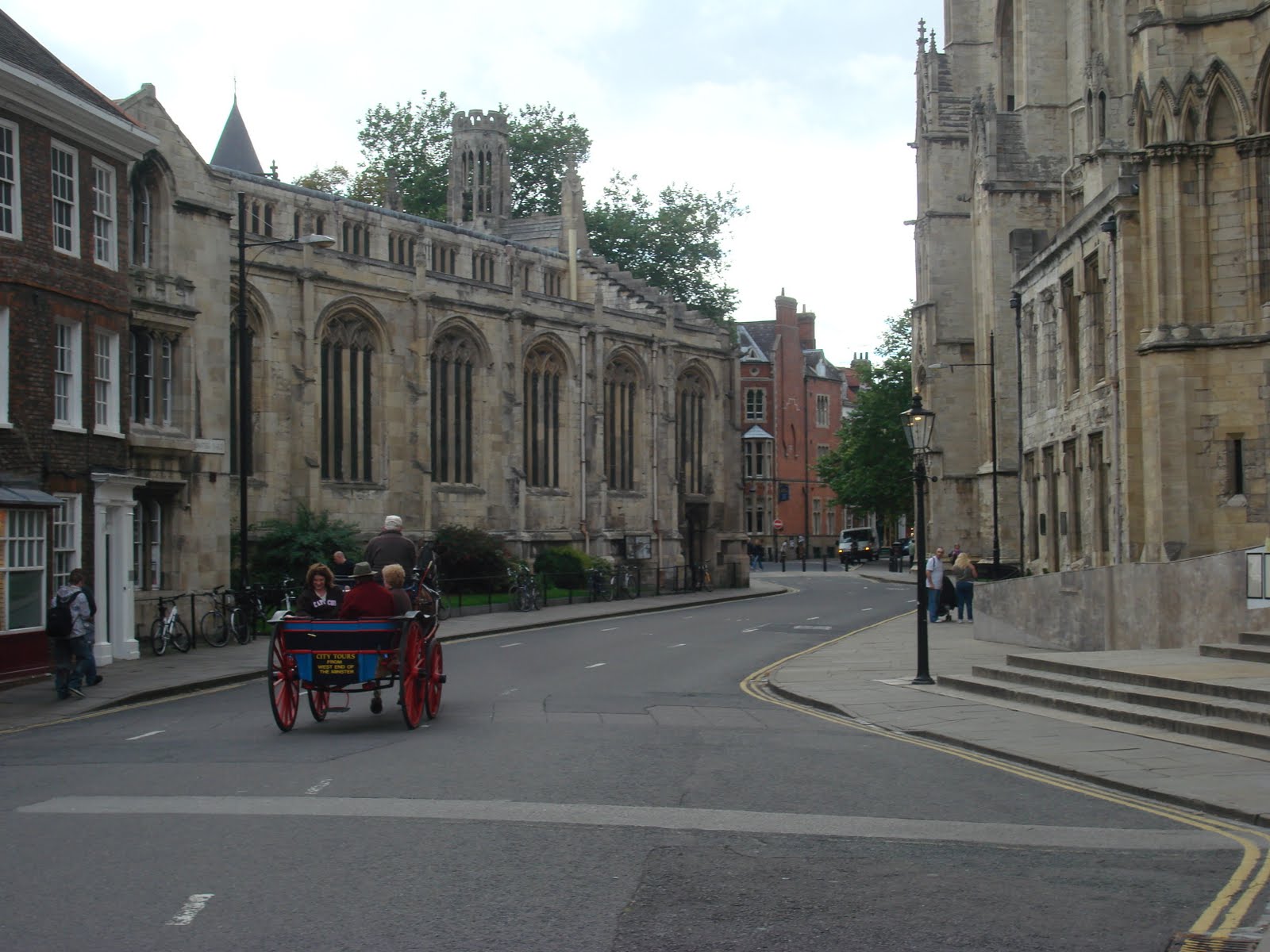
It is the largest church tower in England. That means you have to climb 275 steep steps to get the top. The views from the top by all means are breathtaking and outstanding. Walking along the tower you can see almost all of York, even more if the sky is clear. Not to mention the medieval streets and horse carriages down below that can take you back in time.

My opinions

Needless to say I’m very impressed with the beauty of the Minster, in particular the windows I mentioned earlier, the Screen and the Nave. In my inexperienced opinion York Minster and Westminster Abbey are of equal magnificence.

However when I was there in the late night I came across the visit of the Relics of St Thérèse of Lisieux. Mingling with the thousand visitors and pilgrims in the spacious and bright palace I was really fascinated by the power of religion. It became the clearest memory of my trip to the Minster and the city of York.

Summary: A vital medieval cathedral strongly impressed me.

York Castle Museum - social history brought to life

Advantages: excellent location and fantastic displays of 400 years of local history.

Disadvantages: No audio guide and limited toilet facilities.

On 1 October 2009 I visited York Castle Museum for the first time.

It is a social history museum that is located in York on the very site of York Castle, which was originally built by William the Conqueror in 1068. It is two minutes walk from Clifford’s Tower and five minutes from Jorvik Viking Centre. It is considered to be a landmark in the development of museums and has twice won the York Tourism Award for best attraction.

During the 18th century the museum buildings were used as a prison. First they were a Debtor’s Prison and then later a Female Prison. As a museum it was founded by Dr John Kirk in 1938, who was a Yorkshire country doctor and a passionate collector of historical items used daily in the local area. Today the museum collection is of national importance in its scope and quality. So far over 31 million people have visited the museum.

When I entered the museum there were just a few visitors in front of the reception. The entry prices are £7.50 for adults, £4 for children and £6.50 for concessions. You are entitled to free entry to the museum at any time over the next 12 months. It is open daily from 9.30am to 5pm except for the Christmas period and New Year’s Day.

After buying my ticket a staff member directed me towards the left part of the building. However first I stopped to admire a red fire engine that had belonged to Rowntree, a famous chocolate factory in the area. Beside the engine you can see part of the original bailey walls of York Castle. In my opinion that is the reason for the museum to be named York Castle Museum.

Then I walked up to the first floor, where I saw a few recreated rooms that represented lifestyles from Late Medieval to Victorian and on to post war. So in the Victorian Parlour you can see beautiful furniture, fine china and ‘fresh’ desserts, etc. Those reflect the prosperity and comfort of a middle class family, who lived in the expanding city suburbs in 1870.

Moving on, you pass by a Moorland cottage in the north-east of Yorkshire in 1850s, and then you can see the peat fire, which was the centre of family activity, and was used for heating, cooking and providing hot water. The furnishings were practical more than decorative and often home made. 

Gradually moving back in time you will come across a Georgian drawing room, which is lined with pine panelling from a house in Davygate, and has been painted a fashionable 18th century colour. You can see the silverware, glass and ceramics that are typical of the kind being manufactured in England at that time.

The largest recreated room you will encounter is a dinning room from the 17th century. It belonged to a prosperous family of the period. The family no longer ate with the servants in a communal hall as they had done in mediaeval house. The fireplace was moved to the side of the room; the beams, panelling and furniture are all made of oak, but have darkened considerably with age.

 If the darkness of the room depressed your visit, I bet you will be pleased to go forward in time to a front room in 1950s. This is a living room of a semi-detached suburban house belonging to a working class family at the time of Queen Elizabeth’s coronation in 1953. Here you can see furniture of 1930s, 40s and 50s. Last but not least you can see a television set had already become a new form of entertainment, displacing the hearth as the focal point for the family. It is said that at the time many people purchased television sets especially to watch Queen Elizabeth’s coronation. This recalled my childhood, and how excited I was when in 1980s my family had our first TV set.

If these recreated rooms made me feel like a guest in different families homes the next exhibition of daily used products was more like rambling around the household department of a store. However here the most important thing you should take is your curiosity, not your wallet. You can see almost everything connected with people’s daily life, such as mops, vacuum cleaners, bath tubs, washing machines and refrigerators, etc. There is an empty bucket there. I tried to pull it up, but failed. In the past before the water pipe was introduced to families, women and children had to carry a full bucket of water from distance to home. I did enjoy this section particularly because some displays reminded me of items my family and I had used.


Next I walked downstairs to a gallery "From cradle to grave; birth death and marriage 1700 to 2000". From the name you can imagine how informative it is. Before I visited the museum I had read a few articles about its displays, in particular this gallery. When I was there I was still lost. Slowly moving my feet I passed birth, wedding, till death and mourning. I was surprised to see how complicated it is to dress a baby. In 18th century baby clothes were not just a matter of function and fashion. They were also a declaration of family wealth and status. However the tradition of ‘blue for a boy and pink for a girl’ did not appear until the end of 19th century and the beginning of 20th century. Compared to the beautiful wedding dresses displayed inside a glass studio, Victorian attitudes to death and mourning were more tempting to me. In Victorian times a widow had to be in official mourning for two and half years after the death of her husband. When I read the information panel and saw the black dressing a widow had I remembered an American film’ Gone with the wind’ and understood the desperate feeling of Scarlett O'Hara, when she had to wear the widow dress all day everywhere. The Burneston Parish Hearse, which is displayed in the centre of the gallery, brought the Victorian funeral history more alive.


Leaving the gallery I encountered an exhibition titled Chinese Reflections, which was opened at Chinese New Year, 2008. In this exhibition you can see 300 years of Chinese influence on everyday life in Britain. Needless to say, it was one of my favourite sections. It was here I found Willow Pattern plates and vases, etc, also known as Chinoiserie, which are totally Chinese in design yet completely English in manufacture. When I visited some famous houses or castles in the UK I was surprised to see the owners had so much valuable Chinese porcelain. Now I realise I was being rather ignorant.

Then I passed by the Kitchen display area, where you can see different kitchens in different periods. One of Yorkshire hearth is noticeable. At one corner of the section there is a transparent modern kitchen, which had TV shows. When I visited this section I felt less interested as well as a bit tired, so I did not spend long there.


Following guide signs I walked downstairs and passed through a display of farm tools of the region. I did have a quick look at these tools, but I could not figure out their functions. It’s really a pity most visitors just take this area as a way to next destination- Kirkgate.

Kirkgate is a recreation of a Victorian street and named after Dr John Kirk, the founder of the museum. In the street you can see a woven basket handcart for delivering parcel and mail, a bank, a police station, different shops and a grocery store, etc. It reflects the flourishing prosperity of Victorian times. Sitting on the bench and experiencing the street scenes from early morning till late night I was lost in the sound effects. One month later when I put the keyboard to write this article I still clearly remember the staff member of the grocery store, who was outfitted Victorian dress and explained to me how Victorian shop worked, also the sound of coins being counted in a shop, not to mention the Hansom cab, the horse of which is so real and it made me hesitate to go near it for a picture.


Next to Kirkgate there is an area of Edwardian shops. An ice cream handcart is standing in the front of two shops. At the exit I also played an early slot machine which mimicked an English execution. Unfortunately 20p just gave me thirty seconds to see it. When the prisoner dropped into a hole I finally got the idea this was an execution not a game.


So far I had spent almost 4 hours in the museum. I thought I’d take a break. However I found for such large museum the toilet facilities and the café are somewhat limited. I preferred the fresh air so I left the museum.

Next day in the late afternoon, after visiting the National Railway Museum and Yorvik Viking Centre I popped over to York Castle Museum again to continue my discovery of the rest of the exhibitions. I headed towards the right part of the building and walked upstairs to a weapons gallery, a children's gallery, costume displays and 60s show, etc. Last but definitely not the least I went to the old cells, which once locked many famous criminals in British history including the notorious highwayman Dick Turpin. Because it was near the museum’s closing time a staff member followed me around the cells. In case he lost his patience and put me in the prison I escaped in a hurry, leaving the protest of the criminals behind me.


All in all, York Castle Museum is the best social history museum I have seen. If I had enough time and energy I would like to have spent more time there, especially to have played a couple of old-fashioned games in the old prison exercise yard. If the museum could apply more modern museum technology, such as audio guides and interactive points, I would be further impressed.

Summary: York Castle Museum is perhaps the finest social history museum in England, but a few small improvements would make it great.

I found I’m a Viking!

Advantages: Interesting displays with a lot of interactive possibilities.

Disadvantages: the Journey of Yorvik streets is short and could be slower.

During my four days trip to York City I would like to say Jorvik Viking Centre was the most interesting and enjoyable place I visited. I’m comparing it to sites, such as Clifford’s Tower, National Railway Museum, York Castle Museum, and York Minster, etc.

General information

Jorvik Viking Centre is located within the Coppergate Shopping Centre, just by St. Mary's Square and surrounded by many shops. The building itself looks like an ordinary shop too. In fact most of the building on the ground floor is a gift shop as well as exit from the Centre. Since it first opened in April 1984 it has been hugely popular. Without noticing the long queue at the entrance to the centre you would not consider that it is a tourist site.
(this picture is from internet)

Originally the site was a buried city of the Vikings, who were sea-borne warriors from the Scandinavian area and invaded the North of England in medieval ages. During their stay on these lands they built a small city with houses, streets and it had a population of around 10,000. By the way Jorvik is a name that comes from old English and Scandinavian languages and eventually morphed into York.

From 1979 to 1981 archaeologists supported by York Archaeological Trust excavated the remains left by Vikings around these area. Like the proverbial Roman City, Jorvik Viking Centre was not built in a day. The original Centre was open in 1984 and refurbished in 2001. This re-opening reflects the wealth of detail recovered from the excavations by archaeologists and specialists from many countries. The displays of their achievements at the centre brought history alive permanently.

Jorvik Viking Centre is open daily except for the Christmas period. In summer it opens from 10am to 5pm. In winter it closes one hour earlier.

It's free for York Pass holders. If you are a member of English Heritage you are qualified for 15% discount. Currently there is a charge of £8.50 for adults, £6 for children and £7 for concessions. Do remember you are entitled to free entry to the centre at any time over the next 12 months.

What you can see

Jorvik Viking Centre is on the very site where archaeologists discovered the remains of Viking York and your trip will tell you what life was like 1000 years ago. You can see, you can hear and even smell the life when you travel through a reconstruction of Viking streets.

1. Time Machine

It is the first stage of your journey. A staff member outfitted in Viking style stands at the entrance to a small room named the Time Machine. Entering the room you can see a few rows of benches and a big screen in front of you. After sitting on the benches the staff briefly explains about your journey and how you would be taken back in time. You can see a couple on the screen, dressed in typical costumes of the appropriate time period as you travel back in time. You can feel your benches jolt back and forth until you finally reach your destination: AD 975.

2. Journey of Yorvik streets

At the end of your journey back in time there is an open pod-type contraption waiting for you, which will take you on a ride through the streets of Jorvik. Every pod has 2 rows of seats holding up to 6 people. You can push a button in front of your seat to choose an appropriate language to listen to a commentary about what you see.

Slowly you will pass by two children, who are playing a popular Viking board game called Hnefetafl. Then you will come across the blacksmith's home, an example of an old, simpler, single storey building made from wattle and daub, which suffered from severe dampness. Next you pass the woodturner's home, a brand new cellared building made entirely from oak. Don’t be surprised when the speakers by your ears become rowdy because you are just encountering the woodturner at work as well as an afternoon chat between two men and a woman. The woman is their neighbour in the opposite street and just leans over on her wall.


Also don’t panic if you smell some unpleasant odours in the air, such as rotting fish or even worse than that, in particular when you see a man sitting on a Viking cesspit. Yorvik was home to 10,000 people and covered in filth and muck. Proper sanitation was a long way in the future.


When you ‘ramble’ around Coppergate Street, which was just one of many streets in Yorvik, you will see that people could buy anything they wanted in the market because the Vikings traded goods from across Britain, as well as Europe and Asia.

Granted that the previous smells are not very nice, but when you see a Viking hearth, which was the centre of home life, and the fire was used for light, heat and cooking, you cannot help guessing and smelling what's cooking for dinner tonight.

As you come to the end of your journey through Yorvik streets you will be introduced to the some of the original house foundations, which were discovered exactly where you see them. You also can see how they reconstructed the faces of the Vikings using the skulls they found on the site.


All in all a remarkable journey back through time to AD 975.

3. The Exhibition Hall

In the Exhibition Hall you can get a big picture of Viking life, death, disease and battle, etc. There are many interactive displays for you such as talking with Viking people, trying on a Viking helmet or having your own replica coin struck by a Viking coin merchant. You can also complete a short survey on a touch-screen kiosk to find your ethnical connection with Vikings. Last but not least you can investigate bones including a full skeleton, which were found on the land where you are standing. The skeleton is thought to be that of a warrior, who suffered many serious injuries in battle.

My opinion

I enjoyed my visit very much. So don’t laugh at me when I tell you I travelled on the Time Machine twice. I tried my best to catch every detail during those two visits. For me the idea of the Time Machine was not very attractive, but the performance of the actors on screen made the show very eye-appealing.

The first visit I was sitting in the second row of the pod. I was struggling to understand the explanation, which was in English, coming from the speakers by my ears, so I missed a lot of the scenes. Luckily on my second visit I managed to sit in the front row, so the view was open and fantastically clear. I was very surprised by what I saw. Viking life was so basic at that time yet in AD 980 the Song Dynasty was established in China and the social system was already highly developed. Don’t misunderstand me. It was just that here we are a thousand years later and the roles have been reversed, not that I am saying China of today is backward, but it is now trying to catch up with the West technologically speaking.

Incidentally I completed the survey I mentioned earlier and found I’m a Viking! How could it be? The Vikings’ favourite daily drink was beer instead of my beloved Adam's ale.

Summary: Such an impressive site attracted me to visit twice.

My 10 Snapshots of the National Railway Museum

Advantages: free entrance, fantastic collection of railway related memorabilia.

Disadvantages: none that I could see.

The National Railway Museum (often shortened to NRM) in York has been open to the public since 1975, and now has become one of the largest and richest collections of railway related material in the world. It has won many awards including the European Museum of the Year Award in 2001.

NRM is located in Leeman Road, next to York railway station. There are three main areas open to visitors: Great Hall, Station Hall and Outdoor Play Area. Historically the Great Hall was York’s North Motive Power Depot (an engine shed) which originally had 4 locomotive turntables. Station Hall was the main goods (freight) transhipment station for York and the Works was the York Diesel Locomotive Depot until 1986. Today mainly in the Station Hall there are displays about the historical development of the railway industry and British locomotives. In the Great Hall there is a collection of locomotives from around the globe as well as other items related to worldwide railway history.

The NRM is huge and it has so much to see. An ordinary visitor could easily spend 4 hours there, and a railway enthusiast could use up more than a day. Although I’m not a train fan, I still felt excited by what I saw there. From my visit of NRM in October 2009 I have to say the British people do know how to display their history, and the UK still plays a very important role in the railway industry around the world.

When I write this article and look at pictures I took during my trip many fragments of memory flash through my mind like snapshots. So now I would like to share with you 10 of these snapshots

Snapshot 1: Turntable show

There is a big turntable in the Great Hall. Every day at 11am two staff will work the turntable and explain to audiences how they change the direction of a locomotive. It was the first time ever in my life to see the procedure, and it was completely different from what I imagined. The show is short, but easy to understand, and you really have to see it to believe it is possible to turn around a locomotive.


Snapshot 2: Gladstone engine

It is displayed in a corner of the Great Hall, next to the turntable. I came across it by accident after watching the turntable show. When I read the information panel I realized this engine has a special meaning in history.

It was built at Brighton in 1882 and named after the then Prime Minister William Gladstone. It’s the only surviving British front-coupled express passenger locomotive and is notable for being the first locomotive to be preserved by a railway society.


Snapshot 3: Ellerman Lines

How does a steam locomotive work? To many people it would be a very complicated question; however NRM made it easier for you to understand. They cut a cross-section, longitudinally through an engine named Ellerman Lines. Thus you can see into the three parts of the locomotive: i.e. tender, footplate and firebox. If you are patient enough and follow the introduction numbers bit by bit you will find out what does what. When I finally had worked my way from the tender to front end of the firebox I almost considered myself as a qualified engineer.

Snapshot 4: Cast Iron Footbridge

Historically over 50 cast iron footbridges were used to connect adjacent platforms of ordinary double track stations in the North Eastern Railway region, the first being built in 1891. Today several of the bridges are still in regular use. The bridge on display at NRM came from Percy Main station and is set amongst the engines in the Great Hall. When I walked up the steps I felt I was about to commence a journey, but I was so happy the feeling was more like I just came back home.

Snapshot 5: Chinese Locomotive

This giant locomotive is the largest in the National Collection. The engine was made in Britain and was used in China. Now it has sailed around half of the globe to be back in the country where it was built. I was delighted to be able to see a display from China, in particular when I read the Chinese writing inside the cab.


Snapshot 6: Japanese Bullet Train (as known as Shinkansen)

It is the only Japanese Bullet Train outside Japan and it represents one part of the world’s fastest passenger rail network. It was donated to the museum in 2001 by the West Japan Railway Company. The fascinating thing is that you can climb aboard and sit down to watch TV footage about the use of these trains in Japan. At the time I felt I was on a trip going somewhere in Japan and the train was flying fast.

Snapshot 7: The Duke of Sutherland’s Saloon

It was unusual to have a private saloon on a train in late 19th century. However as a main owner of London and North Western Railway, the Duke of Sutherland owned such a saloon. The carriage displayed in a corner of Station Hall was built at Wolverton for his personal use. One picture on the information panel shows the Duke of Sutherland and Edward VII. Coming from a different culture it’s interesting to see how ‘money could talk’.


Snapshot 8: Palaces on Wheels

This section occupies a large area of Station Hall. It displays Royal Carriages, which once belonged to Queen Victoria, Queen Mary, King Edward V and the present British Queen.

Walk along the red carpet and listen to voice explanations above your head whilst you view the comfortable and luxurious lives that such people lived as they travelled about the UK. When I saw these carriages, which were fully furnished with wardrobes, beds and full bathrooms I thought I was in a mini house instead of a railway museum.


Snapshot 9: Railway collecting dog Laddie

Between the end of 19th century and middle of the 20th century railway collecting dogs were familiar sights at large stations around the country. Laddie was one of these dogs and during his 7 years of work collected over £5000. The amazing thing was after he died in 1960 he was stuffed and returned to Wimbledon Station to continue his collecting career until 1990 when he became part of the NRM collection.

Snapshot 10: Workshop

The Workshop is located on the first floor of the Great Hall. Here you can search for almost any information connected with railways using their computers as well as their extensive library.

There is a very impressive exhibition at the entrance of the Workshop. It shows that since 1828 Britain has exported engineers, workmen, money, carriages, locomotives, wagons, signalling equipment and everything else you need to build and run a railway. So far Britain has laid enough rails to circle the globe twice. It has exported over 45000 locomotives and still earns millions from railway exports. I was surprised with what I read as I know these days that Japan and Germany are the leaders of railway development.

These 10 snapshots were the principal features I recall from my four hours stay there. I know there are still many things I did not see. I’m referring to activities such as: the Flying Scotsman display, taking a ride on the miniature railway in the Outdoor Play Area or a visit to The Works where an interactive gallery offers a live link to York station’s electronic signal box and the chance to catch a glimpse of trains on the real railway. I left the museum telling myself I must visit NRM again one day.

Last but not least don’t be surprised when I tell you NRM is FREE! The museum is open daily from 10am to 6pm (except Christmas day). You can also find a locker to store your personal items while you enjoy your visit. When you feel tired you can always find a seat to take a break on this spacious site. By the way there is a restaurant in the Station Hall and a café in the Great Hall too.

Summary: The National Railway Museum is definitely worth your visit.